
What to look for in a Thai trial class

Are you interested in learning Thai but unsure whether you will enjoy the class, understand the teacher or feel comfortable speaking in front of other people?
A trial class gives you a better answer than another course description. You can hear the language, meet the teacher and notice how the class feels before you commit.
You can arrive without preparing anything or proving that you are good at languages. The useful question is simple: does this teaching make you want to try again?
What a Thai trial class should help you decide
A worthwhile trial should give you enough of the real learning experience to judge:
- how much you will speak;
- how the teacher corrects pronunciation and tones;
- whether explanations make sense to you;
- whether the group feels supportive;
- how online or onsite participation works;
- what the full course teaches after the trial.
You may learn a few greetings or short exchanges during the session. That is encouraging, but the number of words you remember at the end is not the main test.
1. Do you get to speak Thai?
Thai is a language you learn by hearing and using it. A trial that consists mainly of a presentation tells you little about the class experience.
You should have a chance to repeat a sound, answer a simple question or take part in a short exchange. In a group trial, notice whether everyone gets a turn or only the most confident learners speak.
The goal is not to sound perfect. It is to see how the teacher helps you move from listening to trying.

2. Does the teacher correct tones and pronunciation clearly?
Thai tones and vowel length can change meaning. “Good job” is pleasant feedback, but it does not tell you what to change.
Useful correction is specific. The teacher may model the sound again, show the difference between two tones, break a word into parts or ask you to repeat it inside a sentence.
Notice how correction feels. You should be challenged without feeling embarrassed. Research into interaction and second-language learning supports the role of input, learner output and feedback in language development.
3. Can the teacher explain the language in a way you understand?
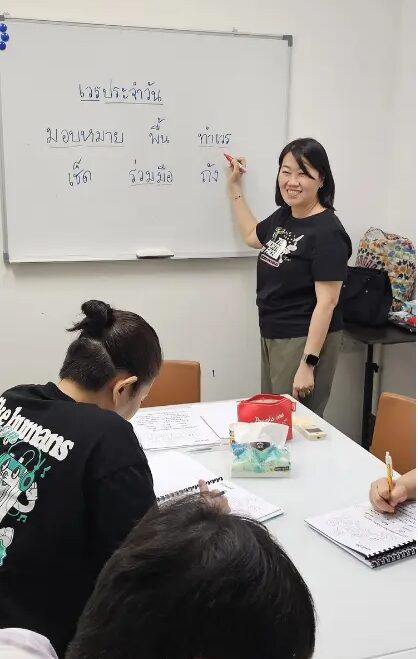
A good Thai speaker is not automatically the right teacher for you. Teaching also requires a clear explanation, a useful example and a sense of when to let you try.
During the trial, notice whether the teacher:
- explains why a sound or sentence changes;
- checks that learners understand;
- answers questions without losing the thread of the lesson;
- moves at a pace that is lively but manageable;
- gives you another chance after a mistake.
A first class will not cover every grammar detail. What matters is feeling confident that questions will be taken seriously as the course becomes harder.
4. How does the group feel?
The other learners affect your experience. A comfortable group makes it easier to speak, laugh at a mistake and try again.
Look beyond whether everyone is friendly. Ask yourself:
- Is the group small enough for real speaking time?
- Does the teacher include quieter learners?
- Do pair or group activities have a clear purpose?
- Can you hear and understand the other participants?
- Would you feel comfortable returning next week?
At Lingo, our Thai group classes have a maximum of eight learners. This gives the teacher room to organise shared conversation and still notice where an individual learner needs help.
5. Does the format work in practice?
If the trial is onsite, consider the full journey. Can you reach the centre comfortably after work or at the weekend? Does the room help you focus?
If the trial is online, notice the sound, camera use and turn-taking. Are remote learners active participants, or are they mostly watching?
If the full course is hybrid, ask how onsite and online learners work together and whether switching attendance mode is possible. Do not assume that the trial format and full-course policy are identical.
Our Thai class format guide compares group, private, onsite, online and hybrid learning in more detail.
6. Is there a real course after the trial?
A lively taster is useful, but you are choosing the teaching that comes next.
Ask what the beginner course covers and what happens after it. The answer should be more specific than “you will become conversational”.
Look for a curriculum that develops pronunciation, tones, vocabulary, sentence patterns and listening. If you may continue for longer, check how Thai script, reading and writing enter the Thai learning path.
Also confirm the practical details:
- the normal teacher and group size;
- the class schedule and delivery format;
- materials or other required costs;
- missed-class and recording policies;
- the next level and how progression is decided.
You do not have to interrogate the teacher during the lesson. Keep the questions that affect your decision and ask the course team afterwards.

What a trial class cannot tell you
One session is a snapshot. It cannot prove how much Thai you will learn, whether every future class will feel the same or how quickly you will progress.
The trial teacher may not be your final teacher. The group may be made up of other trial learners rather than the classmates you will join. Ask if either point is unclear.
Your own nerves can also affect the experience. If you felt shy but the teacher included you kindly and the lesson made sense, that may be a better signal than how many words you remembered.
After the trial, keep the decision simple
You can usually decide with four questions:
- Did I speak enough to experience the teaching?
- Did the correction help me understand what to change?
- Did I feel comfortable with the teacher and group?
- Can I realistically attend the full course?
If the answer is mostly yes, check the curriculum and practical terms. If an important part felt wrong, compare another teacher or format before paying.
Try a Thai class at Lingo
At Lingo, our Thai trials let complete beginners experience our conversation-first teaching before enrolling.
You will hear and use practical Thai, meet one of our teachers and see how we work with pronunciation and tones in a small live class.
Our current Thai trial classes are held at our centre and there is no obligation to continue. Dates change, so check the current free trial schedule on our main Thai page rather than relying on an old listing.
Come as a beginner. The point of the trial is to discover whether learning Thai with us feels clear, useful and enjoyable.