
Thai for travel, culture and everyday connection

Many of our Thai language learners in Singapore love visiting Thailand. They already enjoy the food, the places and the people, and they feel they will enjoy their time there even more when they can have simple conversations in Thai.
Perhaps you would like to greet the taxi driver and share a little joke on the way to your hotel. At a restaurant, you might want to ask what the staff recommend instead of pointing at a picture. If you have Thai friends, a partner or family, even a short conversation can help you feel more involved.
English and translation apps will still be useful. A few words of Thai simply open up more moments. Even when someone speaks English, starting in Thai can show genuine interest and bring warmth to the exchange.
Thai is also closer than it may seem. Singapore has an active Thai community, including associations for Thai residents, workers, students and cultural groups. You may already hear Thai among friends and colleagues, at a favourite restaurant or at cultural events.
This gives the language a life between trips. You can build the basics in a Thai class in Singapore, notice and use them in natural moments here, then bring them with you the next time you return to Thailand. That trip will feel a little different from the last one.
Your experience will change gradually. Here is what that journey can feel like.
Visiting Thailand when you speak very little Thai
You can have a wonderful time in Thailand with very little Thai. In the main tourist areas, many people speak some English, and a translation app can help when they do not.
The familiar routine works. You show a taxi driver the address on your phone. You point at a menu. You ask the hotel receptionist a question in English and hope the answer is clear.
Most of the time, you get where you want to go. But the exchange often ends with the practical task.
There may be a dish on the menu that you would love to know more about, or a taxi driver who wants to ask where you are from. Someone says something with a smile and you wonder whether it was a joke. By the time you open a translation app, the moment has passed.
These moments often give people their reason to learn. They are already enjoying Thailand. They would simply like to understand and join in a little more.
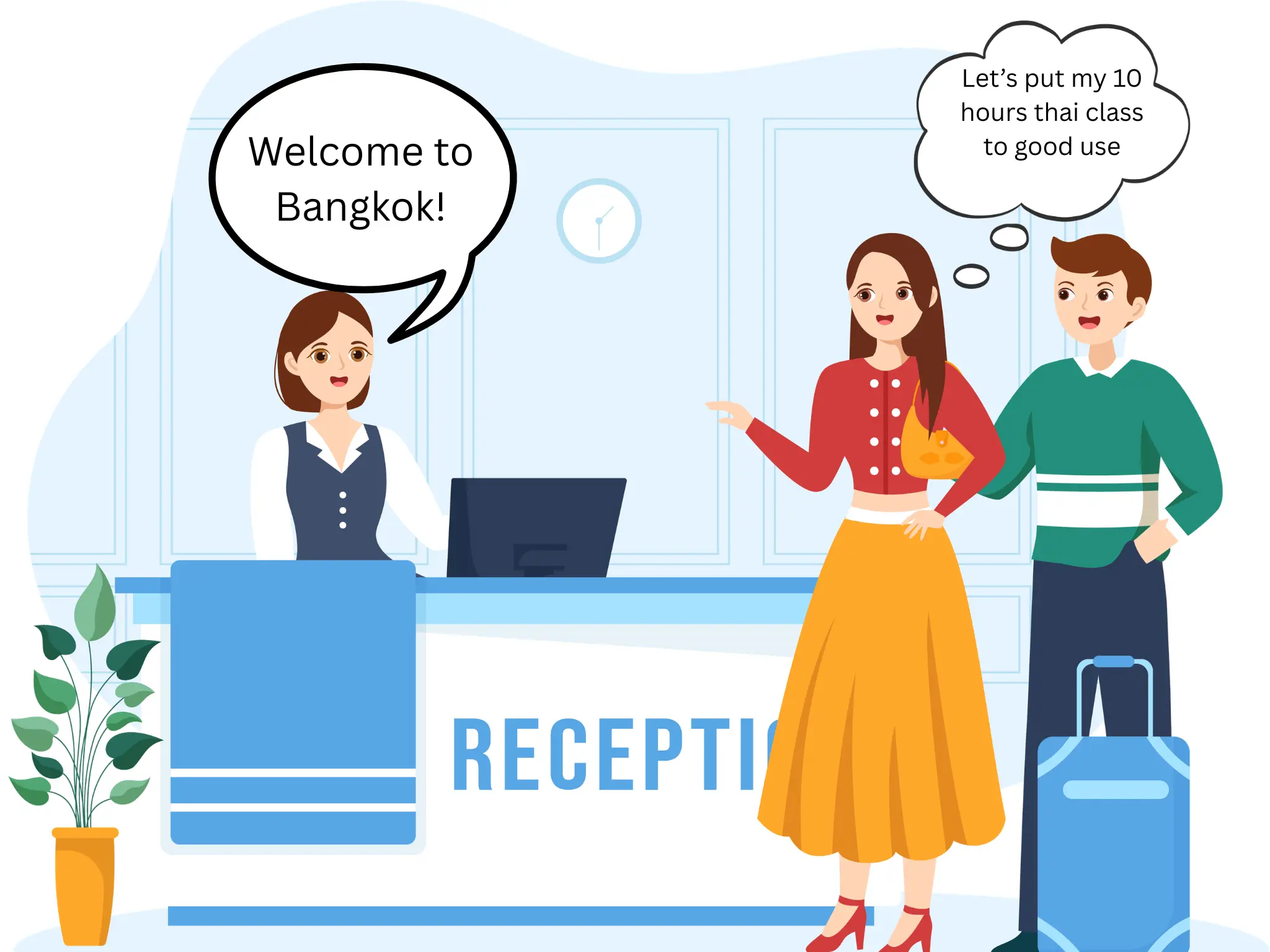
After your first level in Singapore, Thailand feels a little different
After a first Thai level, your conversations will still be short. But they begin to feel like your own. The next time you land in Thailand, familiar parts of the trip start to change.
You can greet the taxi driver, say where you are going and recognise a few words about the route or the traffic. At a restaurant, you can order, mention a preference, check a number and thank the person serving you. In a shop or hotel, you can ask a simple question and catch some of the likely answer.
Sometimes the other person will continue in English. That is perfectly fine. You still started the interaction in Thai, and this can change its mood. A smile becomes a short chat. Someone helps you with a word. The person across from you sees that you are interested in meeting them halfway.
You also gain a little more freedom. You are not reaching for a translator every time you want to say something simple. If the reply is too fast, you know how to ask the person to repeat it or speak more slowly. If the conversation goes beyond your Thai, you can move between Thai, English and gestures without feeling stuck.
This is the first stage in our Thai learning path: useful sounds, tones and everyday exchanges that give you a base for everything that follows.
Over time, Thailand starts to feel more familiar
As your Thai grows, you can stay in the conversation for longer.
The taxi ride may include a chat about the traffic, the weather or the part of Thailand you are visiting. At a restaurant, you can ask about a dish, understand a follow-up question and respond without rehearsing every sentence in your head. You begin to recognise familiar words on signs, menus and messages.
You will also hear more of what is happening around you. A phrase you learnt in class suddenly appears in a café. You notice how friends speak differently from hotel staff, or how a small change in tone makes a request sound softer.
The practical freedom grows too. You can handle more situations without waiting for someone else to translate. When plans change, you have more ways to ask, check and respond. The conversation may still be imperfect, but it keeps moving.
Later in that journey, Thai script, reading and writing give you another kind of independence. Menus, signs and short messages start to make sense, and written Thai supports the words you already know from conversation.
Learn in Singapore, then bring Thai into real life
Thailand is a wonderful place to practise Thai, but simply being there does not automatically build the basics.
You can visit for years and still use the same handful of phrases if nobody has helped you hear the tones, understand the sentence patterns or make sense of the reply. In your class in Singapore, you have time to slow the language down, ask why something is said in a certain way and try again with useful feedback.
Thai also needs a life outside the classroom. A teacher speaks clearly and knows what you have studied. A taxi driver, waiter or shopkeeper does not know which chapter you finished last week. They speak at their own pace and may answer in a way you did not expect.
The two experiences support each other:
- In class, you learn a useful pattern and practise the sounds.
- You try it in a natural moment here or on your next visit to Thailand and hear a real reply.
- You notice what worked, what surprised you and what you wanted to say next.
- Back in class, you can ask about that moment and add another piece of Thai.
Then you try again. Each round makes the language a little less like lesson material and a little more like something you can use.

Language helps you notice culture in everyday conversation
Culture is not a list of rules that applies to every Thai person or every situation. It appears in small choices: how people greet one another, soften a request, show respect, choose a form of address or adjust their speech for the relationship.
Polite particles are a simple example. The Thailand Foundation’s explanation of khrap and kha shows how these short words carry social meaning as well as grammatical meaning.
When you learn them in context, you start to hear more than the word itself. You notice when people use it, how their tone changes the feeling of a reply and how politeness can sound warm rather than formal.
There will always be variation. Age, region, relationship and setting all affect how people speak. Real conversations help you notice those differences, while a teacher gives you a comfortable place to ask about them.
What the journey looks like at Lingo
At Lingo, you can learn Thai in Singapore with conversation from the first level. You work on pronunciation, tones and everyday exchanges so that you can begin using Thai in recognisable situations.
The next levels give you more vocabulary, more flexible sentence patterns and more listening practice. Thai consonants then begin to support the language you already speak, followed by dialogues, short stories and more independent reading and writing.
Our own Thai curriculum keeps these stages connected. Your teacher can help you prepare for the situations you are looking forward to, and the class gives you space to talk about what happened when you tried your Thai in real life.
We keep our Thai group classes to a maximum of eight learners, so you have time to speak and receive correction. You can meet the teacher and experience the class before deciding whether it feels right for you.
Your next visit to Thailand is a lovely reason to begin. If you would like to start before you go, see the current Thai beginner classes and free trial on our main Thai page.